 Skip to content


Reasonable Ball Bearing Turbo Shaft Play and Causes
In one of our articles, we’ve discussed about “Turbo Shaft Play of Journal Bearing Turbos” (check it out if interested👉link), in which we’ve mentioned that ball bearing turbocharger should not have noticeable shaft plays. However, we still receive questions about shaft play in ball-bearing turbochargers. In this article, we will provide a detailed explanation of the underlying design characteristics and operating principles.
Importance of Proper Shaft Play Evaluation
Correctly distinguishing between permissible and impermissible turbo compressor shaft play is essential for reliable turbocharger operation and long-term durability. It is important to note that assessing shaft movement by visual inspection or by hand is not a valid diagnostic method and can lead to incorrect conclusions. A detectable amount of radial movement is intentionally designed into the system.
Accurate evaluation of both radial and axial shaft play requires specialized measuring equipment and defined reference points. Attempting to assess play by hand may mask early warning signs or falsely suggest a fault where none exists. For proper diagnosis, shaft play should be measured using calibrated instruments or evaluated by qualified specialists with experience in turbocharger bearing systems.
Radial vs. Axial Shaft Play in Ball-Bearing Turbochargers
In ball-bearing turbocharger assemblies, shaft play is generally categorized into radial play and axial (thrust) play, each serving a distinct functional purpose. Radial play, which refers to side-to-side movement of the shaft, is intentionally engineered into the bearing system to allow proper oil film formation, thermal expansion, and high-speed rotational stability. When the turbocharger is not operating and oil pressure is absent, a small amount of perceptible radial movement is normal and does not indicate wear or failure.

Axial play, or in-and-out movement along the shaft axis, is far more limited in ball-bearing systems compared to journal-bearing designs. This movement is controlled by angular contact bearings and thrust components, which are designed to handle axial loads generated under boost pressure. As a result, axial play should be minimal and barely perceptible under static conditions. Excessive axial movement may indicate abnormal loading, lubrication issues, or internal component wear.
Proper Way of Checking Permissible Shaft Play
To accurately measure radial and axial play, use either micrometers or dial indicators. Seizing the shaft nut with your fingers and try to move it forcefully to check for factory shaft play is inaccurate. Here’s a guide to the proper way of examine reasonable shaft play.
1. Clean the turbo.
2. Prepare micrometers and dial indicator.
3. Secure housing, and measure the accurate clearance between the shaft and the housing with micrometers, reasonable value is ≤ 0.10 mm.
4. Use dial indicators to check axial play, contact a specialist if the axis is ≥ 0.01mm

Common Causes of Shaft Play in Ball-Bearing Turbochargers
Abnormal shaft play in a ball-bearing turbocharger is typically the result of lubrication, installation, or operating conditions that exceed the system’s intended design limits. Understanding these factors helps prevent premature wear and ensures long-term turbocharger reliability.

1. Lubrication-Related Factors
Proper lubrication is critical to ball-bearing turbocharger performance and durability.
-
l Insufficient oil pressure or oil flow
Inadequate lubrication prevents stable oil film formation within the bearing cartridge, leading to accelerated bearing wear.
l Incorrect oil restrictor selection
Ball-bearing systems require carefully matched restrictor sizing. Excessive restriction can starve the bearings, while insufficient restriction may cause overheating or seal failure.
l Oil contamination
Debris, sludge, or metallic particles can damage bearing races and rolling elements, increasing internal clearances.
l Oil coking caused by heat soak
High exhaust temperatures or improper engine shutdown procedures can carbonize oil within the bearing housing, degrading lubrication and bearing surfaces.
2. Installation-Related Issues
Improper installation is a common source of abnormal shaft movement.

l Incorrect oil feed orientation
The CHRA must be clocked correctly to ensure consistent oil distribution to the bearing system.
l Restricted or poorly angled oil return line
Insufficient gravity drainage can raise internal oil pressure, negatively affecting bearing stability and seals.
l Mechanical misalignment or installation stress
Uneven mounting surfaces or forced alignment can introduce unintended axial loads into the bearing system.
3. Operating Conditions Outside Design Limits
Shaft play can also develop when operating conditions exceed intended parameters.
l Excessive exhaust backpressure
Elevated turbine inlet pressure increases axial thrust loads on the bearing system.
l Turbocharger overspeeding
Operating beyond the designed speed range places extreme centrifugal loads on the shaft and bearings.
l Repeated high-load thermal cycling
Continuous exposure to extreme temperatures can gradually alter bearing clearances over time.
4. Foreign Object Damage (FOD)
Debris or any form of foreign objects circulating in the turbo would ultimately cause damage.
l Debris ingestion through the compressor or turbine
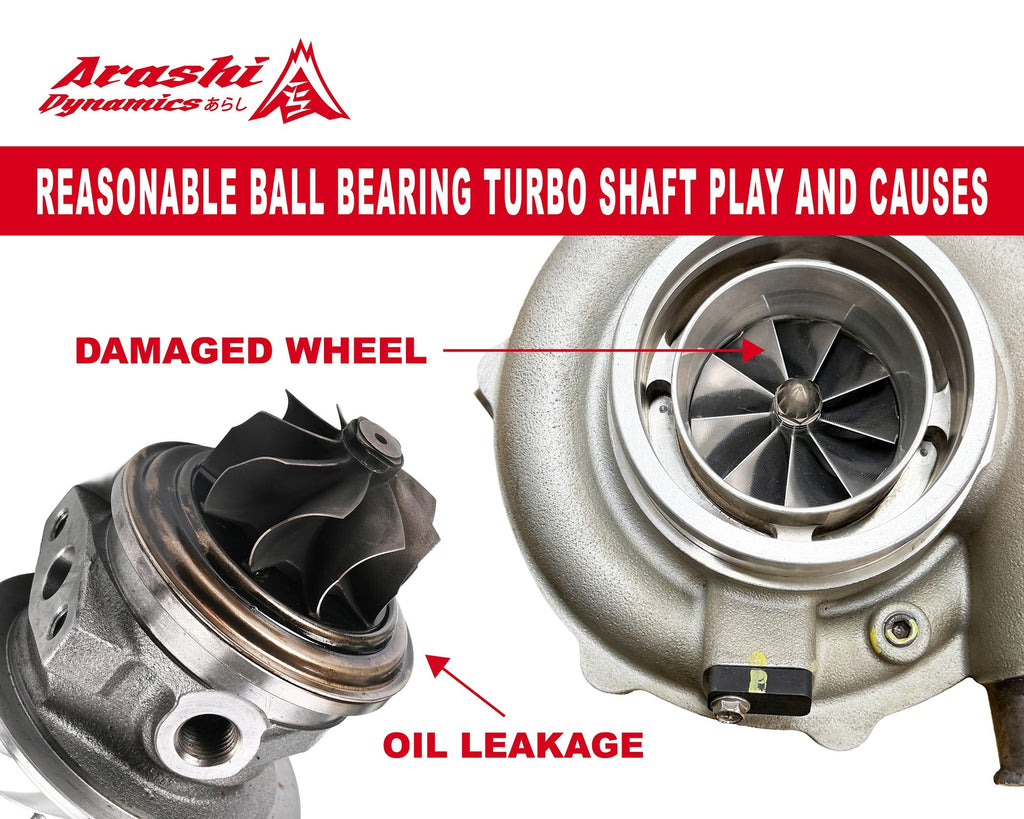
Foreign objects can damage wheels, bend the shaft, or impact bearing races, resulting in measurable shaft play.
l Inadequate air filtration
Fine particles entering the compressor can cause progressive internal damage over extended operation.
5. Component Wear and Fatigue
Turbo parts used under severe conditions would also cause shaft play easily.

l Bearing fatigue after prolonged high-load use
While ball-bearing systems are highly durable, extended operation under aggressive conditions can eventually increase internal tolerances.
l Excessive axial loading beyond design intent
Sustained high boost pressure can overload the thrust system, accelerating wear.
A small amount of radial shaft play is normal by design, particularly when the turbocharger is stationary and oil pressure is not present. However, excessive radial movement or measurable axial play typically indicates an underlying issue that should be inspected using proper measuring equipment.