 Skip to content

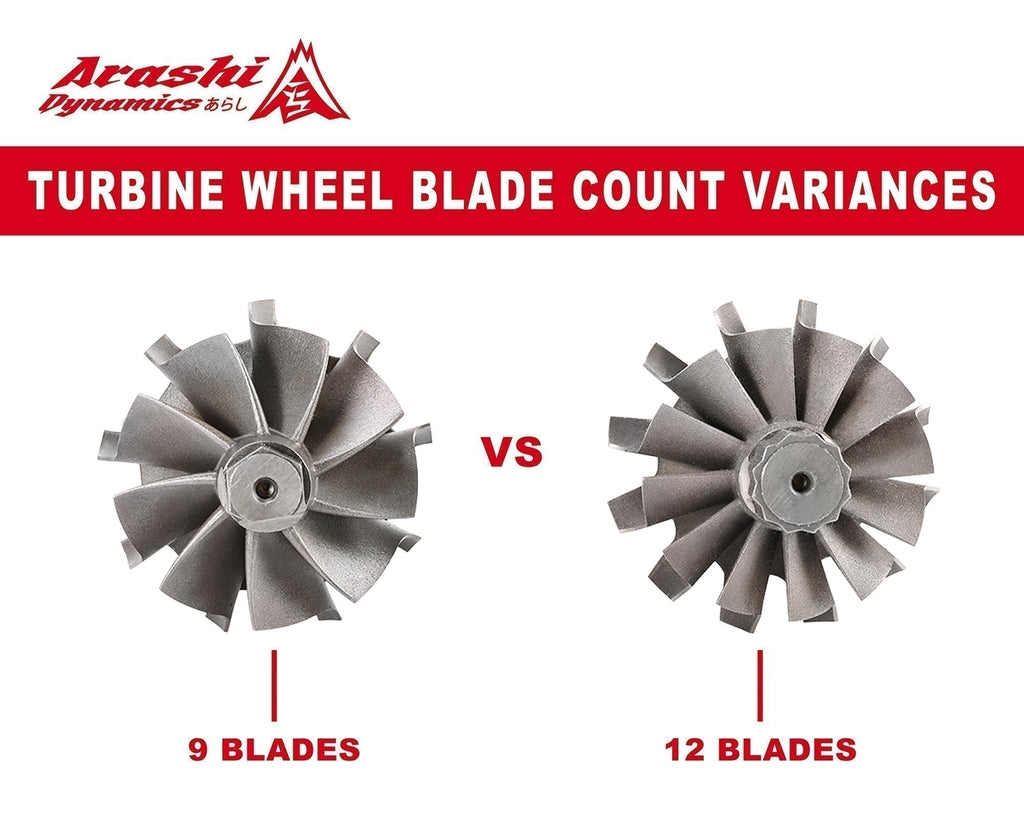

Turbine Wheel Blade Count Variances
When optimizing turbocharger performance, most enthusiasts focus on the compressor wheel—and for good reason. It largely determines how much air your engine can ingest. However, the turbine wheel plays an equally critical role in how efficiently exhaust energy is converted into boost. When properly matched with the compressor end, turbo configuration can significantly influence spool characteristics, power delivery, and overall drivability.
In this article, we’ll focus specifically on turbine wheel blade count, comparing 9-blade vs. 12-blade turbine wheels. While blade pitch and profile also impact performance, we’ll keep the discussion centered on blade count to provide a clear and practical understanding.

Why Turbine Blade Count Matters
The turbine wheel is driven by exhaust gases, and its job is to extract energy from that flow to spin the compressor. The number of blades directly affects how the turbine interacts with exhaust gas:
l More blades (12-blade) à greater surface area to capture exhaust energy
l Fewer blades (9-blade) à reduced restriction and improved flow at higher engine speeds
This balance between energy capture vs. flow efficiency is what defines the performance characteristics of different blade counts.
12-Blade Turbine Wheel: Faster Spool, Stronger Low-End
A 12-blade turbine wheel is designed to maximize energy extraction from exhaust gases, especially at lower RPM.
Advantages:
l Faster spool time due to increased blade surface area
l Stronger low-end response, boosts come faster
l Ideal for street driving, daily usability, and setups prioritizing responsiveness
With more blades interacting with exhaust flow, the turbo can accelerate more quickly, delivering that immediate “punch” many drivers look for in urban or tight driving conditions.

Disadvantages:
l Increased rotational mass (heavier wheel)
l Potential flow restriction at high RPM, which can limit peak power
9-Blade Turbine Wheel: Better Top-End Power, Higher Flow
In contrast, a 9-blade turbine wheel is optimized for high-flow efficiency and top-end performance.
Advantages:
l Higher flow capacity due to reduced blade surface area
l Improved top-end power and sustained boost at higher RPM
l Better suited for track builds, high-horsepower goals, and aggressive tuning setups
With fewer blades, exhaust gases encounter less resistance, allowing the turbo to maintain efficiency at higher engine speeds—translating into stronger peak performance.

Disadvantages:
l Slower spool time compared to 12-blade designs
l Slightly weaker low-end response, especially in larger turbo setups
Matching Turbine and Compressor Wheels
For optimal results, it’s essential to match the turbine wheel with a properly sized and designed compressor wheel. Upgrading the turbine wheel alone may not deliver the full performance gains you’re expecting. A well-balanced turbo setup ensures efficient airflow on both intake and exhaust sides, creating best potential results. It also improves boost response across the RPM range, keeping the vehicle at steady performance. Last but not least, it creates maximized power without compromising reliability, prolonging turbo life span. In short, the turbine and compressor must work as a system—not as isolated components.
Thumb of the Rule
Choosing between a 9-blade and 12-blade turbine wheel ultimately depends on your performance goals:
l Go 12-blade for quicker spool and stronger low-end drivability
l Choose 9-blade for higher flow and maximum top-end power
Understanding these differences allows you to build a turbo system that aligns with your driving style—whether it’s responsive street performance or high-revving track dominance. For the best results, always consider the complete turbocharger setup, including compressor design, turbine housing, and intended application.
find out more:


